


The headline unemployment rate in the United States currently sits at a “healthy” 4.4%. But that number masks the true state of the economy. The U-6 rate — a broader measure that includes the underemployed, discouraged jobseekers and involuntary part-timers — is closer to 8%, or 13.5 million Americans. Yet even that number ignores the tens of millions more who make up the lost workforce: prime-age adults economically inactive due to caregiving responsibilities, perverse benefit cliffs that punish upward mobility and other institutional barriers that have led them to give up looking for work altogether. And that’s before we get to the nearly 40 million Americans trapped in low-wage jobs that leave most of them functionally unemployed — working full-time yet unable to meet even their basic needs.
At the same time, there are 6.5 million unfilled job vacancies currently in the labor market. But once again, that’s just the tip of the iceberg. The U.S. faces severe talent gaps across many of its most critical industries from education and healthcare to construction and the skilled trades. Outdated infrastructure, housing shortages and insufficient healthcare provision among other challenges cost the U.S. more than a trillion dollars each year in lost productivity and untapped potential. This massive mismatch between human capital and unmet need is at the heart of why Peter Diamond, Dale Mortensen and Christopher Pissarides won the Nobel Prize in 2010. They found that even in a “perfect” market, information gaps, coordination failures and other systemic inefficiencies can prevent talent and opportunity from ever finding each other.
As a college intern in 2019 I worked for Ascend Indiana — a nonprofit dedicated to addressing exactly this market failure. I still vividly remember the slide from their executive deck: two arrows running past each other — one representing the state’s talent; the other the needs of its employers. But instead of merely connecting job seekers to vacancies, they focused on building end-to-end employment pathways through strategic partnerships between universities and employers. From full-ride scholarships for tailored degree programs to guaranteed apprenticeships accompanied by a career coach, every step of the journey from enrollment to employment was intentionally designed.
Despite the impact of organizations like Ascend, there’s a surprising lack of language that does justice to the architecture that shapes how people participate in the economy. The closest label would be “workforce development” but that describes what these organizations do, not necessarily what they build. Some might call it “soft” infrastructure, but that’s a catch-all so broad it groups career pathways alongside parks, hospitals and the local fire brigade. Economics does have plenty of terminology for the component parts — physical assets, human capital, industrial policy — but nothing that unifies them into a single, coherent category. That’s Participation Infrastructure: the diverse systems, institutions and mechanisms that determine whether talent and opportunity actually find each other.
Participation infrastructure can be broken down into three interdependent layers: Assets, Access and Agency. Assets are the material foundations that make participation possible from housing and transportation to healthcare and broadband. Without these, nothing else matters. People can’t show up to work without transport links nor can they do a virtual interview without Wi-Fi. We also need the physical spaces — office buildings, co-working hubs, research labs — alongside the digital infrastructure for learning and work to happen in the first place.
Access meanwhile refers to the systems and mechanisms that open doors to opportunity. Schools, universities and training programs equip people with the credentials they need to qualify while internships and apprenticeships bridge the gap between learning and earning. But access also includes the connective tissue like job matching platforms, recruitment pipelines and professional networks that help people find openings they might not discover on their own.
Finally, Agency is what expands people’s ability to choose how they contribute — the institutional support that gives them the capacity to determine what their participation looks like. Career coaching and mentorship help people broaden their horizons, seed funding encourages entrepreneurs to take risks and start new businesses, and subsidized childcare gives parents the bandwidth to re-invest in their careers. Crucially, agency also encompasses the collective power to shape participation itself through democratic processes from worker representation to political engagement. If assets provide the foundation and access opens the door, agency is what allows a person to walk through it on their own terms.
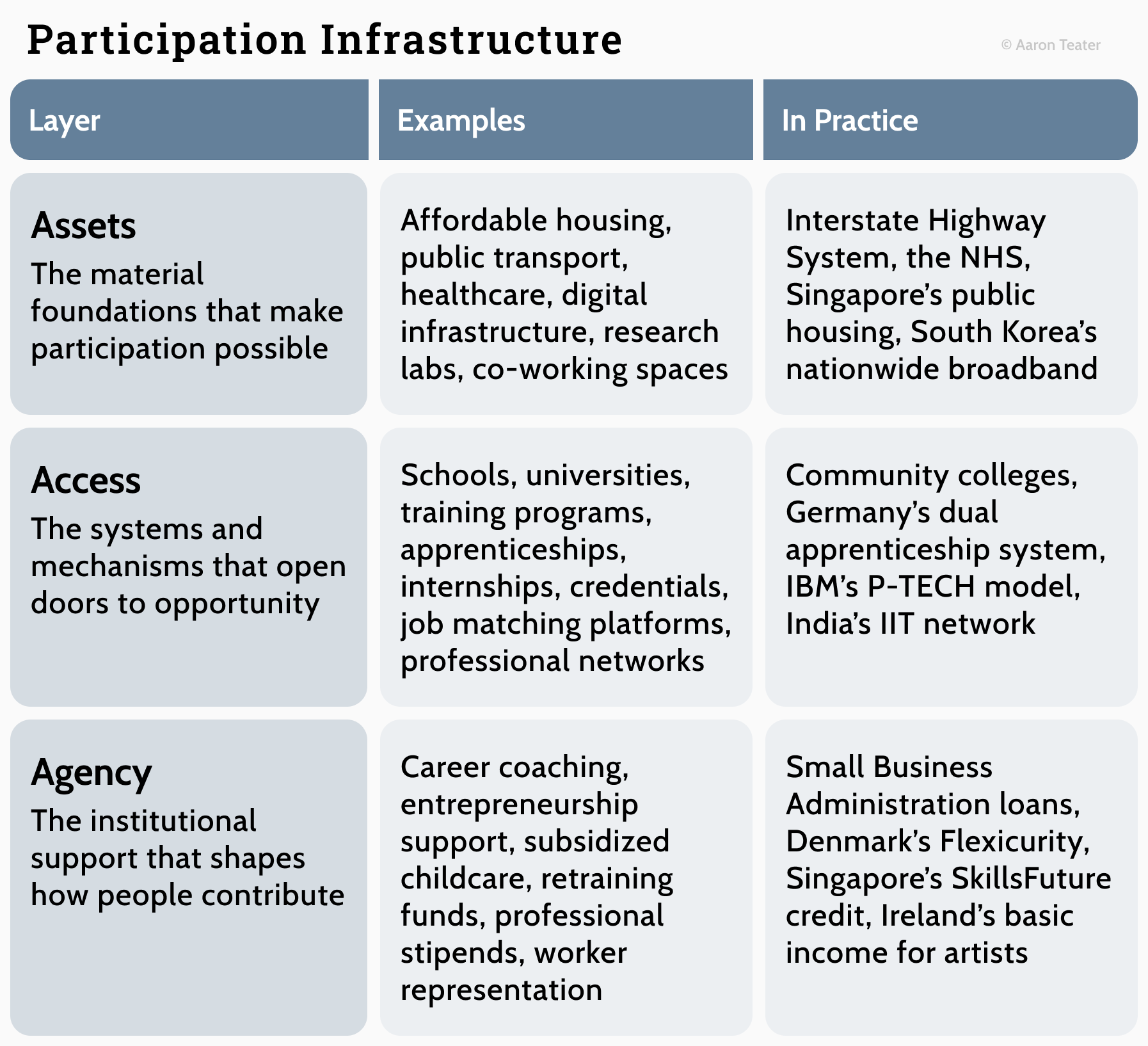
The transformative impact of Participation Infrastructure
One of the most disheartening things when I worked as a teacher at an under-resourced school in Indianapolis was asking my middle school students what they wanted to be when they grew up. For every student that dreamed of being a doctor or professional athlete, I got an equal number that would simply write “the military.” When I asked why, the answer had nothing to do with them liking guns or playing Call of Duty. It was a cold calculation. Having already ruled out college due to their grades and the impossible price tag, the military was the only alternative they could see that offered a clear pathway to economic security.
This isn’t a coincidence. The U.S. military has built arguably the most complete participation infrastructure in existence. From the recruitment tables in high school cafeterias to the GI Bill after service, they’ve essentially reduced the cost of participation to nearly zero. All you have to do is show up and they take care of the rest. Assets like housing and healthcare are all provided. Structured training, clear progression and a robust credentialing system mean service members can build a career. And once you’ve served, the agency follows: the GI Bill funds whatever education you choose, VA loans help you buy a home and specialized support systems can even assist veterans in starting their own business. No other institution in America comes close to offering that package.
Service members honorably earn that level of support. But the military reveals something deeper about where participation infrastructure gets built — and who it gets built for. In its most complete form, participation infrastructure tends to exist where powerful institutions need people badly enough to make the investment. The military needs recruits, so it paves a frictionless pathway from high school to service. Top consulting firms and investment banks need analysts, so they build graduate pipelines that cover relocation, training and promotional pathways from day one. Meanwhile, the U.S. care economy has approximately 1.8 million vacancies and lacks anything remotely comparable to fill them. The same goes for teaching, nursing, the skilled trades and countless other pathways that we say matter but are often the hardest to see and most expensive to walk. Where those gaps exist, nonprofits like Teach For America and Ascend step in to build what the market and the state haven’t — but they’re patchwork by necessity, dependent on philanthropic funding that limits their scale and scope.
This uneven distribution doesn’t just reflect priorities. It determines individual outcomes. A single parent who wants to retrain for a growing industry faces a stack of transaction costs the military would never ask of a recruit — tuition, childcare, transport, lost income during training. A high school graduate in a deindustrialized town may never discover that careers in renewable energy or cybersecurity exist, let alone find a pathway into them. A retail worker barely earning a living wage has no time, money or institutional support to pivot into the skilled trades or healthcare roles the economy desperately needs. In each case, every step toward economic participation is a market transaction individuals are expected to navigate alone. The barrier is rarely talent or ambition. It’s the absence of participation infrastructure.
These individual participation failures don’t just result in personal misfortunes; they compound into systemic economic damage. The longer someone sits idle — or remains trapped in work far below their potential — the more their skills atrophy, their professional networks erode and their confidence wanes. Multiply that across an entire community or region and what might have started as a series of job losses can eventually morph into structural decline. This is what economists refer to as “hysteresis,” a concept popularized by Olivier Blanchard and Lawrence Summers when critiquing Europe’s unemployment problem in the 1980s. Contrary to the prevailing belief that economies naturally recover after a downturn, Blanchard and Summers demonstrated that prolonged unemployment results in economic scarring, permanently diminishing the economy’s productive capacity.
However, hysteresis is not a foregone conclusion. When deindustrialization swept through the American Rust Belt, most places followed the textbook pattern: factories closed, jobs disappeared and communities fell apart. But a handful of places broke that cycle. Kalamazoo, Michigan for example didn’t wait passively for the market to correct itself. Instead, local leaders, businesses and private donors came together to build participation infrastructure before we had a name for it. The Kalamazoo Promise guaranteed college tuition for every public school graduate, public-private research parks retained talent and incubated new businesses, retraining centers upskilled displaced workers and strategic investment revitalized the city’s downtown into a thriving hub for arts and culture. Kalamazoo didn’t just reconnect people to the old economy. It built the infrastructure to participate in the new one.
This brings us to a crucial point: participation infrastructure does far more than just connect people to existing opportunities. It fundamentally transforms what is economically possible. The Kalamazoo Promise not only expanded access to university, it made people stay, which attracted more investment from companies like Pfizer, helping rebuild the local economy around the life sciences and specialized manufacturing. Yet the most powerful example of this dynamic operates on an entirely different scale. When Abraham Lincoln signed the Morrill Act in 1862, granting federal land to every state to fund public universities, the goal wasn’t just idealistic: the Union needed mechanics, industrialized agriculture and a skilled workforce to win the Civil War and build what came after. But by opening higher education to millions of working-class Americans for the first time — providing the assets, access and agency that had previously been reserved for the wealthy — the Act unleashed something no one could have predicted. UC Berkeley, MIT and Texas A&M didn’t just improve agriculture; they produced the scientists, engineers and researchers whose work powered American industrialization, transformed global food production and eventually laid the foundation for the knowledge economy. The entire engine of twentieth-century innovation was the downstream impact of a bold investment in participation infrastructure made the century prior.
The Morrill Act is a humbling reminder that the economy has never been a fixed thing that happens to us. It’s a product of the architecture we build within it. Yet until now, the infrastructure that connects people to economic participation has been fragmented. Not because the pieces don’t exist, but because we haven’t had the language to see them as a unified system. Naming it changes that. What we can name, we can measure. What we can measure, we can compare. And what we can compare, we can deliberately invest in. In a time when advanced economies are stagnating, inequality is deepening and AI threatens to upend the labor market as we know it, the question isn’t whether participation infrastructure matters. It’s whether we’ll build it with the same intentionality the military brings to its recruits, the same ambition Lincoln brought to the Morrill Act and the same urgency that this moment demands.