

In June 2026, UNDP’s Strategic Innovation Unit invited me to present the Participation Infrastructure framework as part of its Global Innovation Series, alongside Dr. Kate Philip, the architect of South Africa’s Presidential Employment Stimulus, and Dr. Philippe Clerc of UNDP Djibouti. The audience was an international community of practitioners working across UNDP’s 170+ country offices.
What follows is a written version of that talk. Most of it is the argument as I gave it. The parts tailored to UNDP’s own work are summarized more briefly toward the end. It also marks the first time I’ve put into writing a second idea I introduced that day: Economic User Experience (EUX), a way of evaluating whether participation infrastructure actually works for the people navigating it.
You can find the full session embedded at the end of this post. All illustrations adapted from work by Jozef Mičic.
The myth of effort
One of the most harmful myths in economic thinking is that if people just work hard, opportunity will follow.
Yet the numbers tell a different story. According to the International Labour Organization, 402 million people around the world want work but can’t access it. More than 2 billion who do have jobs are stuck in informal employment without basic protections. It’s not just that people can’t find work. They’re navigating fragmented architecture that never gives them a coherent pathway into meaningful economic participation.
When we think about employment, it’s usually as individuals navigating a labor market, rather than looking at the infrastructure that shapes participation. As a result, most policy interventions focus on only one part of the system. Workforce development aligns skills with demand. Human capital investment increases worker productivity. Active labor market policies try to better match talent with opportunity. Even when these are integrated alongside wraparound services, it tends to happen at the project level rather than delivering structural change.
Meanwhile, the investments that do make a difference are often the first to go when budgets tighten. In the decade after the 2008 financial crisis, the UK, for example, closed more than a thousand Sure Start children’s centers, cut spending on affordable housing and ended the Education Maintenance Allowance in England, which helped hundreds of thousands of young people stay in school.
Participation Infrastructure
Participation infrastructure offers a fundamentally different way of viewing the economy. Rather than looking only at jobs or skills, it encompasses the entire stack of social and physical architecture that determines how people participate in the economy. It consists of three interdependent layers:
Assets: the material foundations that make participation possible in the first place. This includes housing, healthcare and transportation, but also the physical spaces where economic activity happens, from co-working hubs to research labs. Without these, nothing else matters. A person can’t show up to work without reliable transport, nor can they attend a virtual interview without Wi-Fi.
Access: the systems and mechanisms that open doors to opportunity. Someone might be healthy and able to show up to an office building, but without the right knowledge, skills or credentials, that door remains shut. Crucially, Access also includes discoverability. For too many people, the problem isn’t that the door is closed. It’s that no one ever told them it was there in the first place.
Agency: the institutional support that expands people’s capacity to choose how they contribute. A single parent with childcare responsibilities, student debt and a stack of medical bills has far less economic agency than a healthy graduate living at home. Subsidized childcare, retraining credits and entrepreneurship support all remove barriers and encourage people to take risks and invest in their futures. Agency also includes the collective power to shape participation itself, through worker representation and political engagement.

As I wrote in the introductory essay, “If Assets lay the foundation and Access opens the door, Agency is what allows a person to walk through it on their own terms.”
Singapore’s seamless economic experience
To understand the transformative potential of participation infrastructure, it helps to look at where it exists in its most complete form.
When Singapore became independent in 1965, nearly 70% of people lived in squatter settlements, many couldn’t read or write, and unemployment was in the double digits. Within a lifetime, it became one of the richest countries in the world.
Singapore is often described as a unicorn due to its unique geography and political context. But as a small nation with no natural resources, the country under Lee Kuan Yew understood that its most valuable resource was its people. His primary preoccupation, as he put it, was “to give every citizen a stake in the country and its future.” Rather than competing for investment on cheap labor, Singapore made participation infrastructure the foundation of its economic strategy.
That began with housing. The Housing & Development Board, founded in 1960, rapidly built public homes for Singaporeans. Today, roughly three in four residents live in HDB flats, and around 90% of households own their home.
But Singapore has built far more than housing. Its Assets layer isn’t just checking boxes. It’s a strategically integrated ecosystem of housing, healthcare and transport. Homes are planned around the rail network, and by the early 2030s eight in ten households will live within a ten-minute walk of a train station. Similarly, neighborhood polyclinics put quality care within reach of almost everyone. Singapore was also one of the first countries to roll out nationwide broadband, putting it among the most digitally connected economies globally.
Its Access layer is also one of the strongest in the world. Mandatory bilingual education equips every citizen to participate both at home and abroad. A robust network of polytechnics and ITE colleges means university isn’t the only pathway into a dignified career, giving the country a dependable pool of engineers, technicians and skilled tradespeople. And at the top of the stack, A*STAR’s research PhD pathways train the scientists and innovators designed to power the next wave of growth.
Finally, its Agency layer is where things really get interesting. The Central Provident Fund isn’t just a retirement account. It’s a mandatory savings vehicle that funds the major investments people make throughout their lives, from education to buying a home to supporting their own retirement. Alongside it sits the 3M healthcare financing architecture: MediSave (mandatory healthcare savings), MediShield Life (universal insurance) and MediFund (a safety net, so no one has to go into debt to cover medical bills). On top of those financial vehicles, things like the Baby Bonus give parents cash gifts and matched savings for their children in addition to heavily subsidized childcare. And SkillsFuture credits help workers retrain for emerging industries as technology and automation change what work gets valued.
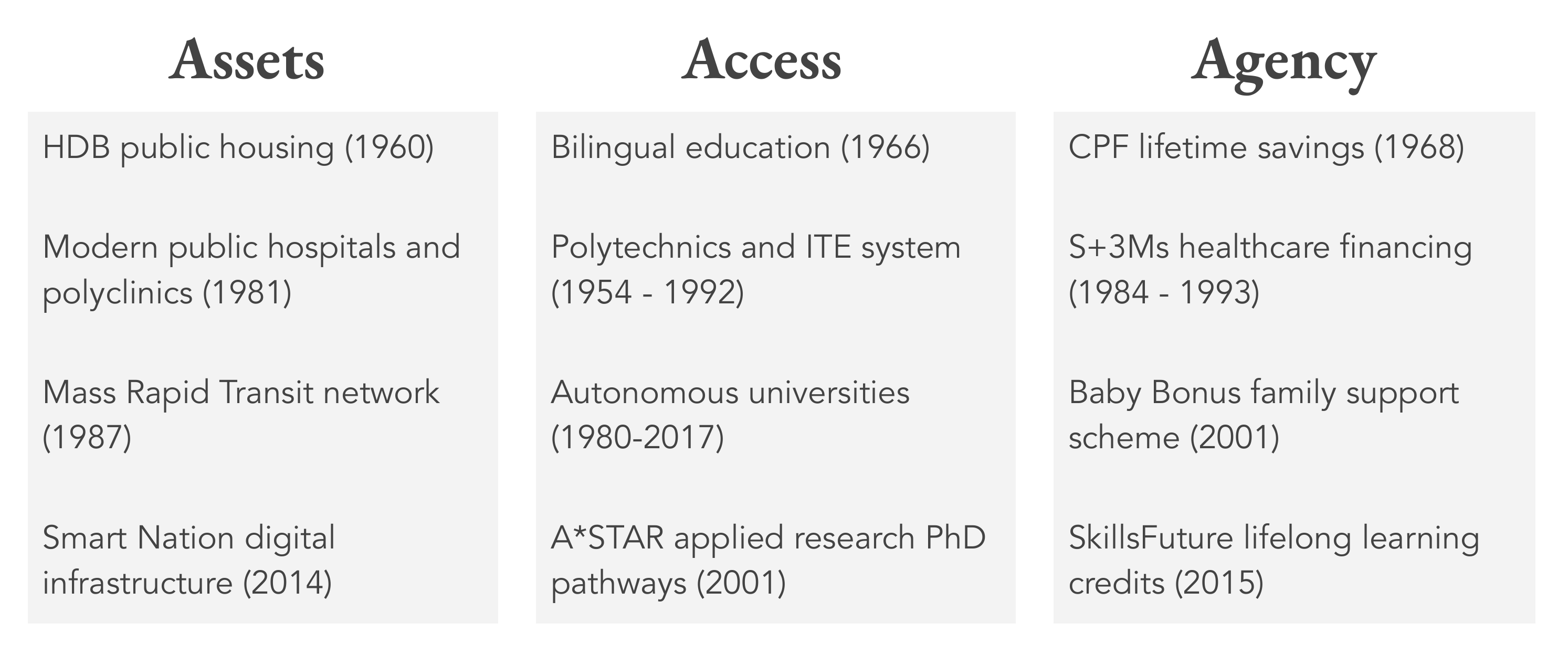
As a result, very few Singaporeans experience the transaction costs and debt burdens that limit economic participation for many of their counterparts across the world. Put together, Singapore has built what could be called a seamless economic experience. From birth to retirement, barriers to participation have been removed at nearly every stage.
Children are born into a stable foundation of housing, healthcare and bilingual education. Diverse and affordable training pathways aligned with industry needs mean people have meaningful routes to choose from. And once people have entered the workforce, their savings and career progression are able to compound free from debt. Lifelong learning keeps people contributing as the economy evolves, and dignified retirement is made possible by the wealth that’s been accumulated from a lifetime of participation.
This is what happens when a country builds participation infrastructure intentionally from the start. Not as social spending but as core economic architecture designed around people’s capacity to participate in the economy.
From human error to system error
Yet that seamless economic experience doesn’t extend to everyone. Foreign workers make up nearly two in five members of the workforce, and more than 1.2 million hold Work Permits, concentrated in construction, manufacturing and domestic work. They are formally employed, documented and taxed. But the participation infrastructure they navigate looks completely different.
Even The Straits Times has asked why Singapore accepts conditions for migrant workers that its own citizens would never tolerate. Many arrive already in debt from recruitment fees. Their permit is tied to their employer, restricting their mobility. They live in isolated dormitories, with restricted access to healthcare and few pathways to credentials that would let them progress. It’s a humbling reminder of how participation infrastructure gets built, and who it gets built for.
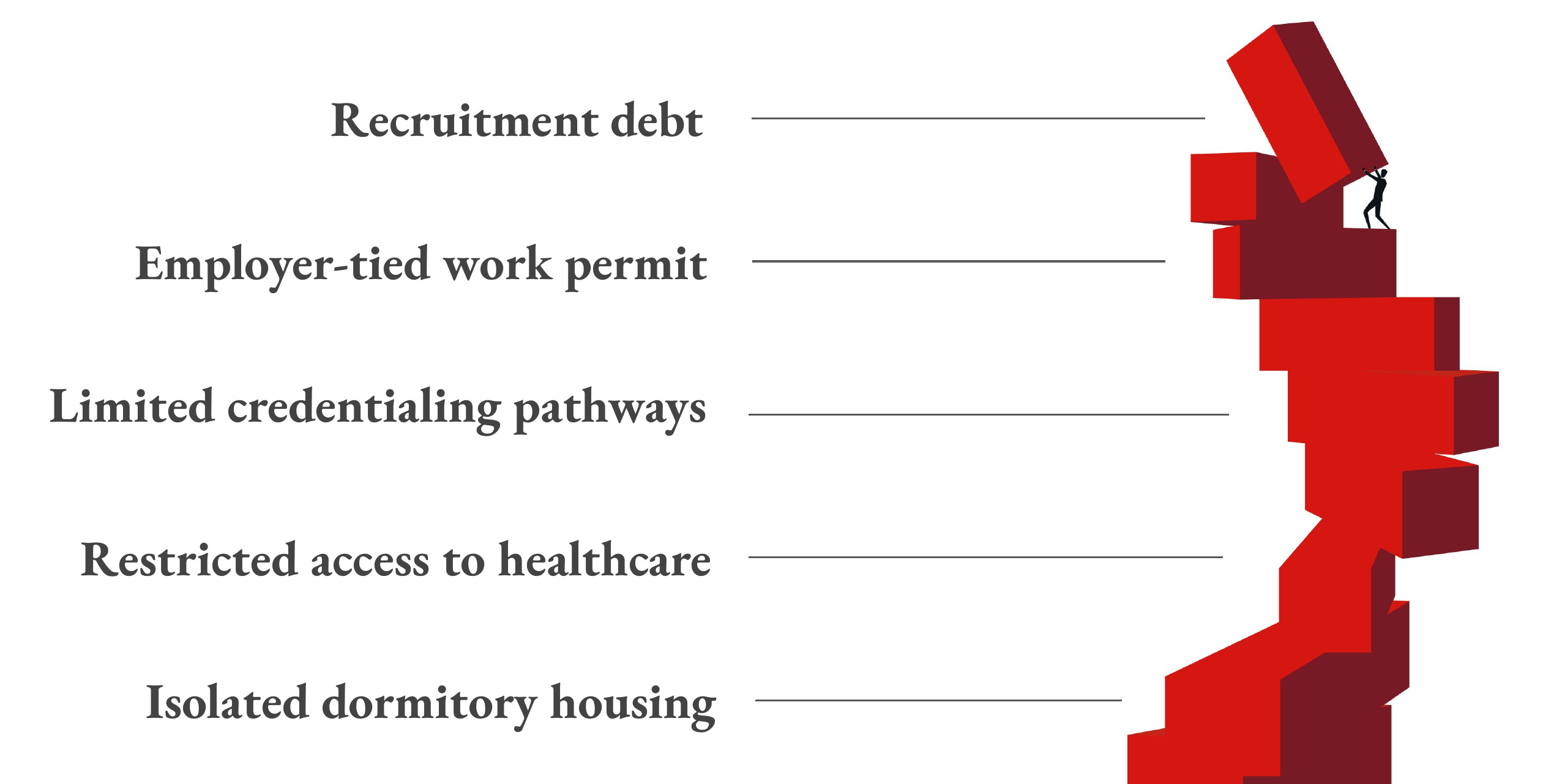
And when a system isn’t built for someone, we have a tendency to blame them when things go wrong.
Don Norman, the cognitive scientist who gave us the term “user experience,” has spent his career showing why that instinct is almost always mistaken. In The Design of Everyday Things, he argues that human error is usually the result of poor design, and that really “it should be called system error.”
Applying that same lens to the entire economic system is how we operationalize participation infrastructure and evaluate whether it’s actually working for the people it’s meant to serve. That’s what I call the Economic User Experience. Rather than asking whether people are trying hard enough, it asks questions of the system itself:
What is the end-to-end journey of someone navigating the economy?
Where do people experience friction or drop out of the system altogether?
Does the system punish people for mistakes or help them recover?
Is the system designed for all users or only a select few?
Asking these questions lets us not only diagnose where the economy is broken, but also design the architecture that makes it genuinely work for everyone.
Why this matters for UNDP
For the UNDP audience, I connected the framework to two shifts already underway in its own work. Its move from fragmented projects to portfolios grounded in systems thinking enables this kind of human-centered design. UNDP has also recently introduced the concept of the Transformation Stack: the institutional capacity for delivering long-term systems change, from dynamic capabilities to system finance.
If the transformation stack is the institutional DNA needed for change, then participation infrastructure is what that capacity should be directed toward. And the economic user experience is how we evaluate that architecture based on the lived experience of people actually navigating the economy rather than aggregate measures.
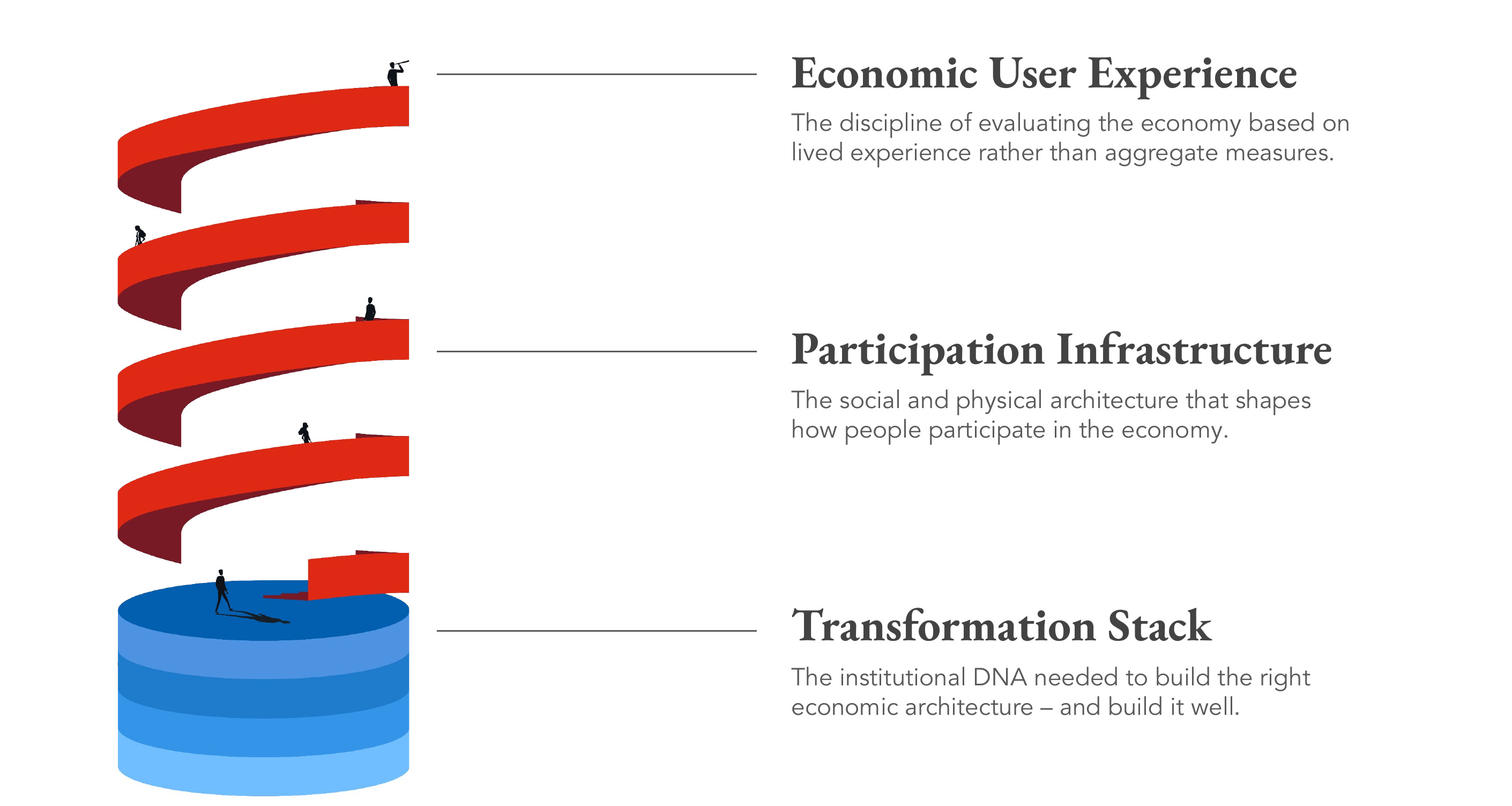
For an organization working across more than 170 countries, that combination matters. Country teams are already grappling on the ground with the fragmented architecture this framework describes, from informal labor markets to returnees with no clear pathway back into work. Participation infrastructure gives them a way to see those challenges as a single system, and to design interventions that work across all three layers rather than one at a time.
Just as importantly, it helps make the case for investment both internally and with governments. Much of what makes up participation infrastructure is still treated as discretionary social spending, defended program by program. Naming it allows us to see it for what it actually is: investment in the productive capacity that makes economies grow. That’s the difference between a project that gets funded once and a system built to last.
You can watch the full session below. If you’re working on any of this, whether in government, development or on the ground, I’d love to hear from you.