

In his diagnosis of why Britain has nearly a million 16-to-24-year-olds not in education, employment or training, Alan Milburn arrived at a stark conclusion: “No amount of reform to individual policy areas or institutions alone will fix this. The architecture itself is the problem” – fragmented systems across education, employment, health and welfare that were never designed to ensure young people can meaningfully participate in the economy.
Unfortunately for the UK, that architectural failure is not unique to the Neet crisis. As Vicky Spratt vividly illustrates in her work on Generation Screwed, even the people who have seemingly done everything right are still being failed by the system. Homeownership that’s priced out of reach, compounding student debt, extortionate childcare costs and suppressed wages mean the once-thriving professional class is now experiencing downward economic mobility, leading many to delay parenthood, move back home or, in some cases, leave the country altogether.
What Britain is experiencing is not the inevitable consequence of low productivity or leaving the European Union but the collapse of the country’s participation infrastructure: the full stack of economic architecture that determines how people participate in the economy. While decades of policy have optimised for market efficiency and fiscal discipline, the architecture that matters most for people to contribute has been left to erode. The result is a generation being locked out, people working harder for less and an economy falling behind its peers.
Unlike his predecessors, Andy Burnham understands the challenge that lies before him. His commitments since taking office already point in the right direction: good growth in every postcode, investing in people’s success rather than paying for failure, parity between technical and academic education, and no dead ends so that young people don’t fall through the cracks. But what his agenda still lacks is a framework for building coherently across the entire participation stack that speaks both to markets and to a public increasingly convinced the economy is “broken by design”.
Beyond public control
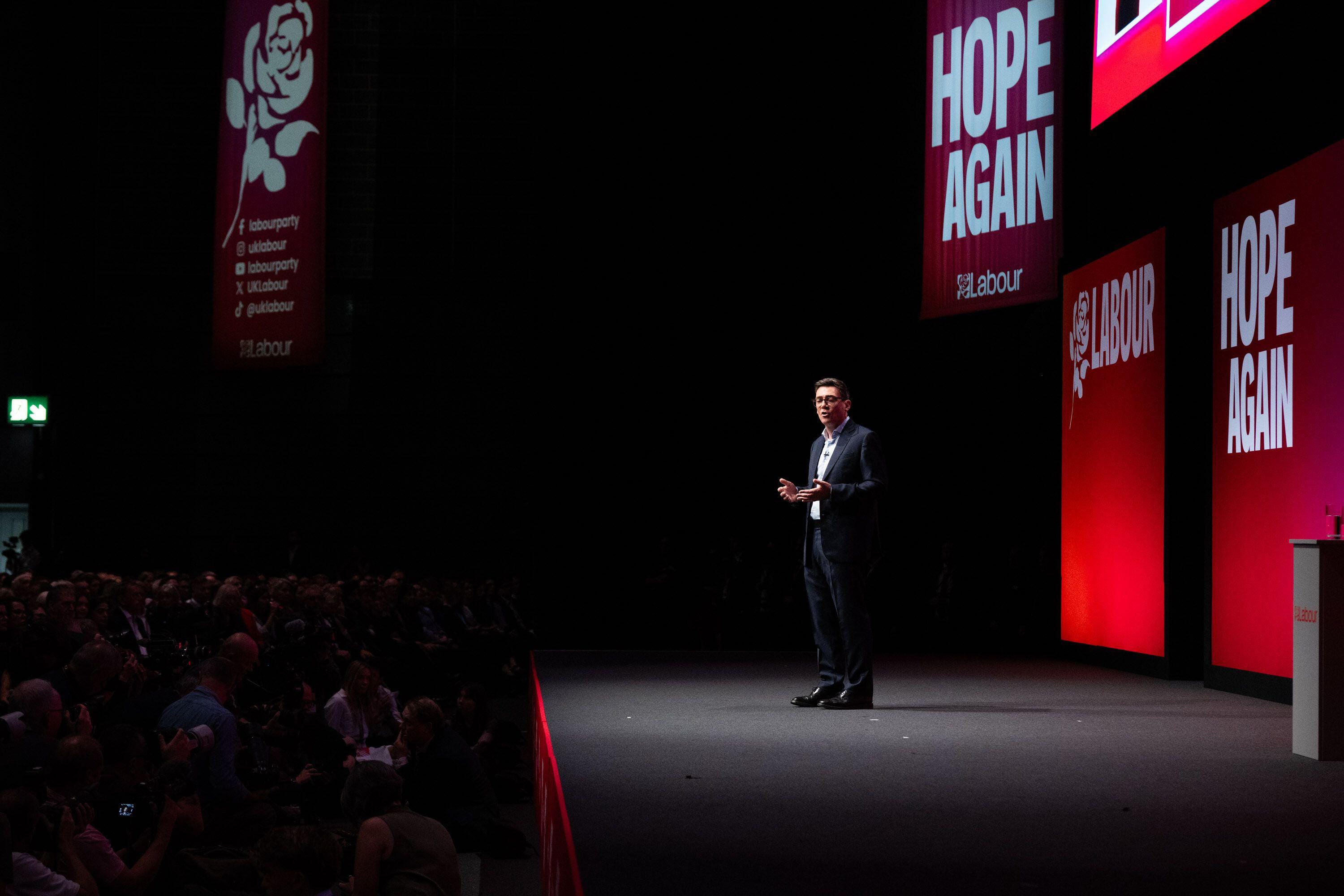
In his first party conference speech as prime minister, Burnham said his theory of growth starts with taking back public control over the essentials of living. It’s an approach he honed in Greater Manchester, where local control over the city’s buses lowered costs and improved service delivery. Drawing on Mathew Lawrence’s Productive State framework, he plans to scale that approach nationally by lifting the ban on public ownership of water, establishing the Great British Grid to get energy costs back under control and embarking on the biggest council homebuilding programme since the post-war era.
But if public control is the starting point, then what comes next? For Burnham, the answer is to devolve power to the local level so places are empowered to create the optimal conditions for businesses to thrive while giving people the support they need to be employed by those businesses. It’s a sound theory of growth, but while Burnham has a detailed blueprint for public control and devolution, he has yet to articulate the equivalent for investing in people’s success. That’s where participation infrastructure comes in, both as a framework for completing his theory of growth and as an organising logic that would make his agenda greater than the sum of its parts.
Participation infrastructure consists of three interdependent layers: assets, access and agency. Assets are where the Productive State operates – the essentials of living that make participation possible in the first place, from housing and healthcare to transport and digital infrastructure. Without these, little else matters. Access refers to the pathways that sit on top of that foundation – the education, skills and credentials that lead to opportunity, as well as the discoverability of those pathways: are people aware of all the options available to them? And agency is what empowers people to move through the economy on their own terms. Subsidised childcare, entrepreneurship support and retraining entitlements are all examples of institutional mechanisms that expand people’s capacity to take risks or change direction, while democratic processes like worker representation give people the collective power to shape participation itself.
When Burnham says the UK has made some “wrong turns” over the last 40 years, that includes not just the centralisation and privatisation of power but also the dismantling of the country’s participation infrastructure. Starting with its assets, roughly 2.8 million social homes have been sold off since Right to Buy started in 1980, while the political will to supply more has repeatedly fallen short. This has fuelled a housing crisis that constrains economic mobility, limiting people’s ability to move near quality jobs while putting homeownership out of reach for much of a generation. Similar patterns have played out across transport and healthcare. In the decades after bus deregulation in 1986, usage outside London fell by 32.5% while rising 99% in the capital – the only place in England that maintained public control. More recently, the NHS waiting list has nearly tripled since 2010, a period in which health spending was severely constrained prior to the pandemic. To make matters worse, long-term health issues are now the leading cause of economic inactivity among working-age adults.
The less visible story is what Britain has done to its access layer. According to a 2024 report from the International Monetary Fund, “the UK workforce has larger and more chronic skills gaps than in most peer countries”, predating both Brexit and the pandemic. Much like the country’s assets, this didn’t happen by accident. Public spending on adult skills has dropped by 30% over the last two decades, with the steepest cuts coming after the financial crisis. Adult learner numbers have fallen sharply as a result, particularly in England’s most disadvantaged communities. The picture is even starker for young people. Since the Apprenticeship Levy was introduced in 2017, participation for under-25s has declined by around 35%. Because employers have increasingly used the levy to upskill existing employees who already hold degrees, Milburn argues “the entry-level provision that matters most for young people outside work has been hollowed out”.
Meanwhile, the academic route that Britain has increasingly told young people to take now comes with a hefty price tag that directly undermines their agency. From 1962 to 1998, university was tuition-free, with maintenance grants to help cover the cost of living. Students in England now graduate with an average debt of around £50,000, effectively taxing participation before it has even begun. Another example of agency architecture being stripped away is the closure of more than 1,300 Sure Start Children’s Centres, which integrated childcare, early education and employment support for families with children under five. The Institute for Fiscal Studies found that Sure Start delivered benefits worth twice its up-front cost by reducing the need for public services, increasing lifetime earnings and generating higher tax revenue from those earnings. At the same time, the collective side of agency has fared no better. Since Margaret Thatcher came to power in 1979, union membership has been cut in half, with only a quarter of British workers covered by collective bargaining agreements.
Taken together, these were not separate policy decisions but the unravelling of the same architecture, one component at a time. Each cut was made in isolation across siloed policy areas with their own mandates, their own budgets and their own definitions of what good looks like. This is what happens when a country lacks both the organising logic needed to treat participation as the product of a single system and the understanding that participation infrastructure is not discretionary welfare spending but capital investment in the productive capacity that makes economies grow.
More than just buses
While the UK was taking apart its participation infrastructure, Burnham was quietly building across all three layers in Greater Manchester, even if he didn’t have the framework to articulate it. For all the praise that gets showered on the Bee Network, his most consequential achievement was shifting the city region’s growth model away from deregulated private capital and towards broad-based investment in people’s capacity to participate.
Although the economy he inherited back in 2017 was already growing, it was largely driven by decades of the very neoliberalism Burnham rails against – private investment in the city centre at the expense of nearly everything else. Predictably, Greater Manchester’s growth has mirrored the wider trajectory of the UK: highly unequal and heavily concentrated in the core while the outer boroughs have lagged behind.
It wasn’t until 2023 that Burnham’s own vision for Greater Manchester started to become reality. That was the year the Trailblazer devolution deal gave him unprecedented power over education, housing and transport, alongside finally being able to bring the city’s buses back under public control. Within a year, he had introduced the pioneering MBacc technical education pathway, pledged 10,000 new council homes and set up the GM Rail Board to integrate commuter trains with the Bee Network.
Then, in 2025, the landmark Integrated Settlement arrived, putting an end to Whitehall’s siloed funding pots and allowing Burnham to organise his economic project as one cohesive programme. The Good Growth Fund – a nearly £2 billion investment vehicle blending the settlement funding with pension capital and a £500 million partnership with the National Wealth Fund – is what emerged from that coherence.
Unlike Greater Manchester’s neoliberal era, the GGF deliberately spreads investment across all 10 boroughs, building affordable housing next to reliable transport links, expanding employment spaces and revitalising the high streets that serve those communities. Crucially, developers and businesses who take the fund’s money must create apprenticeships and T-Level placements, directly complementing the MBacc pathway and the city region’s £114 million investment in adult skills programmes.
Alongside the GGF, Greater Manchester has developed innovative services like EnterprisingYou and Build a Business to support entrepreneurs, while the WorkWell scheme provides anyone 16 or older with a work and health coach to help them overcome barriers to employment. Underpinning all of this is Greater Manchester’s Good Employment Charter, Burnham’s own voluntary scheme for higher workplace standards and a real living wage, which is now required as part of the GGF and covers over 800,000 workers across the city region.
The question isn’t whether Burnham knows how to build participation infrastructure but whether he can do it at the level the national scale demands. His plan to devolve similar powers to every region by 2028 while helping local leaders set up good growth funds of their own is a step in the right direction. But absent a shared account of what to build with that power, you get twenty different answers to what good growth looks like. Aside from the real delivery challenges of varying capacity and capability across regions, Burnham will still need cohesive national architecture if he wants devolution to translate into shared prosperity.
What good looks like
When it comes to robust participation infrastructure with national coherence, Europe’s two most competitive economies offer a useful precedent – not just for what to build but how to design it. Switzerland and Denmark have both topped the IMD World Competitiveness Ranking in recent years while the UK has languished in the mid-to-high twenties.
Both countries excel in an area Burnham has already made a priority: parity between technical and academic education. But parity alone is not enough. What sets Switzerland’s model apart is its interoperability. Not two parallel tracks of unequal standing, but fluid movement between them. Two-thirds of Swiss school leavers go down the Vocational Education and Training (VET) route, involving a multi-year apprenticeship with around 250 occupations to choose from. Apprentices can then move into an applied university that blends teaching and practice, continue on to advanced vocational colleges or simply skip higher education altogether. While VET graduates can still enter a traditional university, their peers on the academic track can also move the other way, provided they complete a year of work experience supported by structured pathways into internships and work-study programmes. What makes the Swiss model even more elegant is that those routes stay open, with 12% of upper secondary qualifications each year awarded to people aged 25 or over.
That is one of the gaps in Burnham’s agenda: so far it is heavily weighted towards young people without necessarily embracing the principle of continuity. A technical pathway from age 14 is a real advance, but what about the 45-year-old whose job has just been automated by AI? This is where Denmark offers a useful lesson. Much like the UK today, the country made some wrong turns in the 1970s and 80s. By 1993, it was facing a severe unemployment crisis of around 12% and its debt-to-GDP ratio had hit an all-time high. Instead of more austerity, the government introduced Flexicurity: freedom for employers to hire and fire as needed, backed by generous, time-bound unemployment insurance. But what makes it work, alongside robust collective bargaining, is a comprehensive suite of state-funded training programmes, career coaches and job-matching services that give everyone a high-quality on-ramp to their next opportunity. Rather than a safety net for people who “fail”, Flexicurity is universal architecture that enables people to continuously participate whether they’re a construction worker or a biomedical researcher. In addition to leading the EU in AI adoption, Denmark now has a debt-to-GDP ratio of only 28%, having run consecutive fiscal surpluses for much of the last decade while nearly tripling its defence spending to more than 3% of GDP.
This is why universality is so important. Unless everyone can use the architecture, it becomes exclusionary by design, capping its transformative potential. Nowhere is that more true than in England’s social care system. Unlike the NHS, it is not free at the point of use. Anyone with assets above £23,250 pays for everything themselves. According to Carers UK, over a million people have left work due to caring responsibilities over the last two years, with an estimated 6.7 million balancing employment with unpaid care. Burnham’s plan for a National Care Service might seem like good social policy, but it’s also participation infrastructure in all but name. Every person released from caring responsibilities is someone who can re-enter the economy, a family member who can invest in their career, a potential entrepreneur who finally has the bandwidth to start a business. The architecture creates a cascade of participation that a means-tested system simply cannot – including dignified employment pathways for the care workers themselves.
Which brings us to the final principle of good participation infrastructure: plurality. A system can be interoperable, continuous and universal, but still channel everyone towards the same narrow set of destinations. As Justine Greening, the former Conservative education secretary, said in response to Burnham’s parity push, “There’s a third route we need that isn’t vocational, isn’t academic, which is entrepreneurship… There is still no pathway for somebody who has an amazing idea and wants to get on with it”. That’s exactly the gap Innovation Fund Denmark is designed to fill – de-risking entrepreneurship at every level, from 12-month programmes that include financial support and mentorship to large-scale partnerships aimed at addressing society’s toughest challenges. Participation infrastructure isn’t only about unlocking existing capacity; it’s about expanding what the economy can become. The best architecture enables diverse forms of participation to emerge, while directing activity towards what society needs most, whether that’s climate adaptation or mental health provision.
Without these principles, you can build assets that don’t connect, access that’s uneven or agency that never materialises. This is particularly important as Burnham devolves power to the local level. Switzerland solves for this by setting its vocational education framework nationally, and leaving delivery to its 26 cantons. Each one has its own VET agency with its own employer relationships, and industry associations define what the training contains rather than merely advising on it. The result is a system that is genuinely local while being nationally coherent. That’s the approach Burnham needs to bring to the UK, applied not just to vocational education but to the entire participation stack.
The case for investment
According to Andy Haldane, former chief economist at the Bank of England, one of the biggest risks to the Burnham project is that markets are already starting to see his premiership as a “traditional tax and spend socialist government with better TikTok videos”. That’s the same Andy Haldane who, earlier this year, praised the Good Growth Fund as a “fantastically innovative” model for spurring growth outside the South East.
To counter that narrative, Burnham needs to demonstrate that his agenda is categorically different. Not tax and spend, but capital investment in the country’s participation infrastructure. Milburn has already made the fiscal case in his review of the Neet crisis: for every £1 spent helping young people into work, Britain spends £25 paying for their benefits. One of those pays for itself through a stronger tax base and economic growth while the other pays for the failure to make that investment in the first place – a failure that he estimates costs the UK £125 billion a year. That’s more than the entire education budget and nearly double what currently gets spent on defence. The challenge for Burnham is whether he can shift that spending from managing decline to expanding what’s possible.
Pulling that off is less about getting the maths right than it is about articulating a narrative that survives both market scrutiny and public scepticism. The good news for Burnham is that Britons are already halfway there. As Anoosh Chakelian has documented, people have shifted in recent years from seeing the economy as a naturally occurring phenomenon outside the government’s control to believing in a “designed economy” actively shaped by policies and political priorities. What’s been missing is the language for what a designed economy should actually consist of. Participation infrastructure fills that gap. Not only as a design specification, but as an investment logic and a vocabulary for change.
When Andy Burnham left Cambridge in 1991 and returned to Liverpool, he found himself in a position familiar to many today: unable to find a quality job in the place he calls home. Forced to move to London, he says he felt like a failure. Decades later, he now has the power to change that story for millions of Britons. His ten-year plan represents an opportunity for the government to operate on a time horizon long enough to actually build a system that works. That means not just undoing four decades of wrong turns, but deliberately investing in the architecture that will define Britain’s economy for the next 40 years.